Sunlight to Bunches: How Light Shapes Palm Oil Yield
James Loftis
Space-Time Tunnel LLC
As with any plant, sunlight sets the ceiling on how much fruit an oil palm can produce. However, across most estates in tropical South East Asia it is rarely the limiting factor holding yields down. Water supply, soil nutrition, and management practices are often the major yield-limiting variables. Still, understanding the relationship between sunlight and plant growth helps us better understand our products, optimize our protocols for planting and make accurate predictions about yield years before a fruit bunch is harvested.
This article walks through how an oil palm turns sunlight into fruit, why effects from a particularly cloudy wet season show up in harvests over 2 years later, and whether or not seasonal wildfires and the resulting haze/smoke conditions are likely to limit production.
How Sunlight Becomes Fruit
When the sun rises above Indonesia’s oil palm plantations, it bathes the trees in solar energy on the order of 16-18 megajoules/m2 per day. However, only part of the sunlight reaching the palms is useful to the plant’s carbon metabolism and this is referred to as photosynthetically active radiation (PAR). PAR is defined as light with a wavelength in the 400 to 700 nm range that plants absorb to drive photosynthesis, and it only accounts for about 45-50% of total surface solar radiation. Satellites often report total radiation in the form of surface solar radiation downwards (SSRD), and PAR is usually estimated from this number by a simple conversion:
PAR = (0.45)(SSRD)
The amount of biomass a palm produces depends on three key factors:
How much PAR arrives at the canopy of a mature tree
How much of the arriving light is captured by the trees
How efficiently the tree can convert the captured solar energy into new plant growth and increased biomass
The canopy of a mature oil palm can absorb as much as 90% of available PAR, meaning that the total amount of sunlight arriving is more important than the tree’s ability to absorb it. Radiation use efficiency (RUE) is the ratio of produced biomass to intercepted light, and for oil palm literature values range from 1.3-1.7 grams of biomass per megajoule of intercepted PAR. While this is only a moderate value compared to other plants, for mature oil palms a large portion of the biomass growth is in the form of fruit bunches from which palm oil is extracted, and this fact enables oil palm to out produce every other oil crop per hectare.
How do Stress Events Today Reduce Yields 2-3 in the Future?
Fruit bunches, from which palm oil is extracted, take about three years to develop from a juvenile inflorescence into a harvestable bunch. A mature palm tree can house up to 50 inflorescences, all at different points in their growth. This presents a major challenge to analysis efforts, because during that time any carbon deficit from a lack of sunlight will affect the growth of each inflorescence in unique ways. How the inflorescences are affected will depend on where it is in its life cycle, demonstrated in the table below.
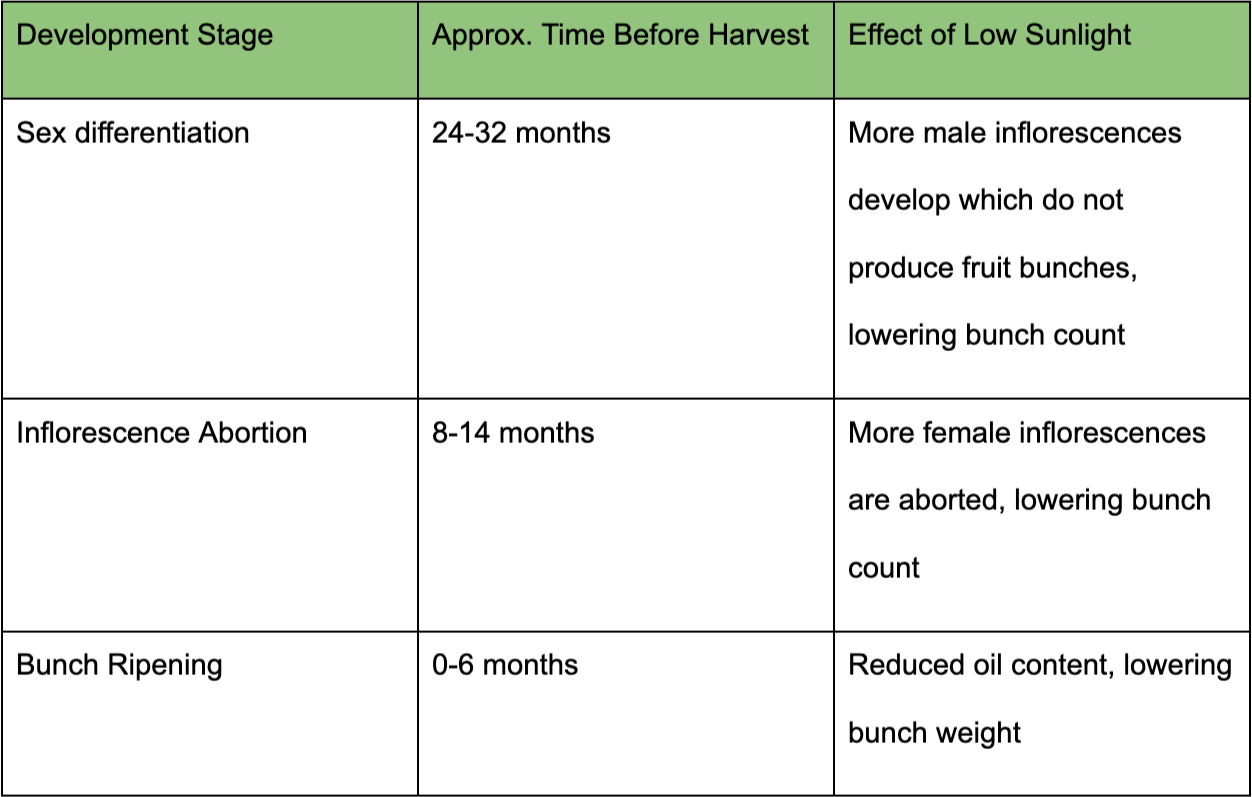
Table 1.
Effects of Reduced Sunlight on Oil Palm Productivity during Development
Since the effects of reduced PAR appear differently depending on where the palm was in development, a particularly dull trimester will affect not only the next harvest but also harvests 2-3 years in the future. This staggered response often makes the relationship between sunlight and yield look weaker than it really is, and means simple month-to-month or year-to-year comparisons are not enough to fully understand the effect of sunlight on yield. Our yield prediction work starts from an established crop and hydrology model that serves as a base layer for later analysis, and handles sunlight using the RUE framework described earlier. It uses this to calculate the potential biomass growth from energy supplied by sunlight, and then scales that growth potential down based on stressors such as poor water supply, poor aeration or a lack of nutrients. Any reduction caused by reduced sunlight capture shows up by lowering the maximum potential growth before any other stressors act on it. Since light is incorporated into the potential growth calculation, it does not need to be added as a stress term but a reduction in captured sunlight is still seen by the post-processing layer and time-lagged accordingly.
Is Light Limiting Yields in Indonesia?
Under normal conditions, the short answer is almost always no. Daily solar radiation in Western Indonesia averages around 4.5 kWh/m2 or an equivalent 8-9 MJ/m2 of PAR a day. Commercial plantations achieve high yields in this range, although it sits below the crops optimum levels for growth. Even so, seasonal and regional variation can drive plantations yields down, and this is amplified as weather patterns grow more intense and anthropogenic disturbances increase in number.
Indonesia straddles the equator and thus receives a large amount of sunlight year round across all of its islands, and differences in solar radiation from one island to the next are primarily caused by cloud cover. The seas surrounding the Western and equatorial islands are some of the warmest on the planet, and provide the warm, moist air that makes this region one of the cloudiest on Earth. Cloud cover builds steadily throughout the wet season running from October to April which can mildly limit light availability, but these periods are also when plant stress from water deficit is lowest and the potential effect on yield is smaller. In the dry season, the water deficits brought on by a lack of rainfall are by far the most impactful environmental factor and cloud cover has a negligible effect. It is important to note that human caused events such as peat fires can still affect yield in material ways.
Smoke and haze from peat and land fires cut incoming PAR substantially, and these events most often occur during the dry season and are most severe during El Niño years when water stress is at its highest. This makes it a challenge to determine whether water or light stress is driving yield losses, and capturing these effects in a model requires solar radiation data that actually reflects the smoke blanketing these regions. Many widely used reanalysis data sets such as ERA-5 calculate SSRD using a long-term average of aerosol levels rather than what is actually being observed on the ground, so they tend to overestimate available solar radiation during severe haze. This matters most in years like this one, with fire events linked to a strong El Niño rivaling the worst seasons of the past 30 years. In order to get a more realistic picture of how haze and smoke are affecting our plantations, we supplement the standard radiation data with aerosol observations that capture the haze effects actually occurring during that time period. As long as the solar radiation data we are collecting reflects the dimmer light conditions on the ground accurately, we can make high quality predictions about the potential yield of our palms and improve our understanding of how these trees interact with and respond to the environment around them.